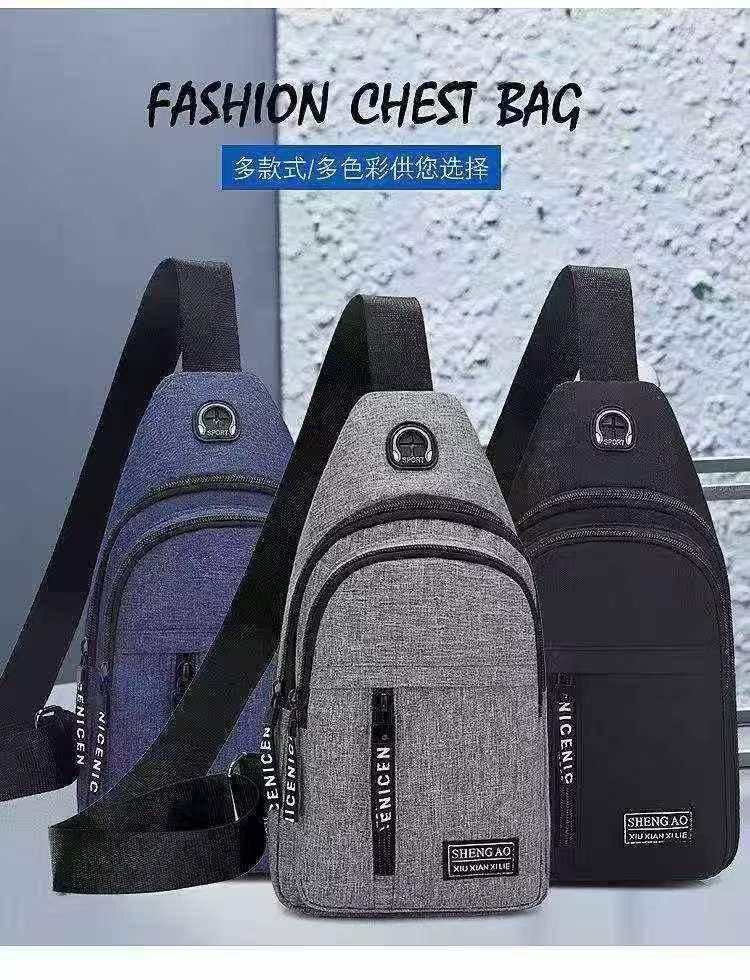
A bag range can look simple in a photo and become complicated in an order. Two similar-looking chest bags may use different fabric, strap hardware, lining or carton packing. Two backpacks may look equally suitable for a retail shelf while one has a better zip, a stronger seam or a different way of protecting the bag in transit.
This guide uses two current reference lines to show what a buyer should confirm before placing a wholesale order: a fashion chest bag and a casual everyday backpack. The current reference prices are RMB 8 and RMB 16 per piece. Those figures are a starting point for an enquiry, not a final offer until the specification, colours, quantity, packing, availability and delivery terms are confirmed.
Chest bag and backpack: quick comparison
| Buying point | Fashion chest bag | Casual everyday backpack |
|---|---|---|
| Reference model | LUME-BAG-001 | LUME-BAG-002 |
| Current reference price | RMB 8 / pc | RMB 16 / pc |
| Style shown in the reference photo | Chest or cross-body carry with an adjustable strap and front zip pocket | Casual backpack with front zip pocket, side slip pocket and adjustable shoulder straps |
| Material and dimensions | Confirm before quotation | Confirm before quotation |
| Colour range and mix | Confirm per order | Confirm per order |
| MOQ, packing and availability | Confirm per order | Confirm per order |
The price difference does not by itself prove which product is the better commercial buy. A chest bag may suit a lower-ticket impulse purchase, while a backpack can justify a higher retail price because it carries more and serves a daily-use function. The right first order depends on the market, the retail price band and the amount of information the buyer needs from a test.
Why test both forms instead of ordering one large batch
A small first order is useful because it tests more than demand. It reveals which colours sell, how customers describe the size, which display style attracts attention and whether the product survives the local delivery chain in good condition.
A chest bag is usually an easier add-on purchase. It can be displayed near small accessories, travel goods, phone products or fashion items. A backpack has a larger visual footprint and often competes in a different part of the store. Testing one or both lines can show where the local retail opportunity sits before a buyer commits to a deeper assortment.
What a product photograph does not confirm
- The exact fabric composition, coating and colour fastness.
- Finished dimensions, strap length range and usable compartment sizes.
- Zip, buckle and adjuster quality after repeated use.
- Whether small accessories shown in the photo, such as a decorative charm, are included.
- The number of pieces per carton, carton dimensions and gross weight.
- Whether the requested colours are available together in the required quantities.
- The final price basis and whether inland freight to the loading point is included.
These are not theoretical questions. They determine how the buyer will describe the item to retail customers and how the shipment will be costed. A written quotation should turn each uncertain point into a confirmed line rather than leaving the buyer to infer it from an image.
Use a sample to test the details that matter
- Open and close every zip several times and check whether the puller is easy to grip.
- Load the compartments with typical products the end customer will carry.
- Adjust the chest strap or backpack shoulder straps through their full range.
- Inspect seams, lining, edge binding and the points where the strap joins the body.
- Check the colour under daylight rather than relying only on a studio image.
- Drop-test the retail packing and confirm how the product will be protected in the master carton.
A sample cannot prove the performance of a full production batch, but it can expose obvious mismatches before the deposit. Record the approved colour, material, dimensions and included accessories so the production and inspection checks refer to the same item.
Build a colour assortment around sell-through, not personal preference
A wide colour range looks attractive in a catalogue but increases stock risk. For a first order, begin with colours that suit the widest part of the target market, then add one or two accent colours. Ask how the colours are packed and whether the supplier can ship a mixed colour order.
For both reference bags, the exact colour availability and minimum quantity per colour must be confirmed. A price quoted for one colour in one quantity should not be assumed to apply automatically to a more fragmented colour mix.
How quantity changes the commercial answer
The unit price is only one component of the order. At a small quantity, handling and carton preparation can represent a larger share of the cost. At a larger quantity, the buyer should still confirm pieces per carton, gross weight and the space the shipment occupies. A low unit price attached to inefficient packing may not produce the best landed cost.
Compare the delivered cost of the complete buying decision: approved product, colours the market needs, packing that protects the goods, and freight to the intended destination.
A clear quotation request
The fastest way to get a useful answer is to give the supplier enough information to quote the exact version you are considering:
- Country, destination city or port and the expected order date.
- Which model: chest bag, backpack or both.
- Approximate quantity per model and the desired colour split.
- The target retail price or the intended end-user use case.
- Required material, dimensions or sample reference.
- Packing requirement, carton markings and private-label needs.
- Whether the quotation should be ex-works, FOB or delivered.
If the destination and packing are unknown, ask for both the product price and the assumptions behind it. A quotation that clearly states its terms is easier to compare than one low number with no delivery basis.
Compare landed cost line by line
| Cost line | What to confirm |
|---|---|
| Product | Exact model, material, dimensions, colours and included accessories |
| Packing | Pieces per carton, carton size, gross weight and retail packaging |
| Factory or warehouse handling | Who prepares the goods and what is included in the unit price |
| Inland freight | Distance to the loading point and whether transport is separate |
| Export and destination charges | Which documents and clearing costs are excluded |
| Working-capital cost | Deposit, production time, transit time and balance-payment timing |
This structure also helps spot an offer that appears cheaper only because it has moved packing, transport or compliance work into later charges.
Red flags in a bag quotation
- A final price is given without quantity, colour or packing being discussed.
- The supplier cannot explain which items are included in a photograph.
- The carton count and gross weight are missing from a shipment quotation.
- The price is described as final before current availability has been checked.
- Freight is omitted without a clear statement that the price is ex-works.
For the chest bag and backpack shown here, the next step is to compare the exact requirements rather than the photograph alone. Send the intended market, quantity and colour mix first, then confirm samples, packing and the current commercial offer before committing to volume.